Wednesday, May 21, 2008

Japa - Recalling thou name in silence, through the mind and the inner self

Nama Article 22nd May 2008
 

The word japa in the Sanskrit language is defined as - 'Japa Vyaktaayaam Vaaci' and 'Japa Maanase Ca';


Meaning: Enunciate the mantra clearly and also say it mentally.


Repeated rhythmic enunciation of a mantra with unperturbed mental concentration is defined as the japa of that mantra.


The Agni Puraana explains this as below -


Jakaaro Janma Vicchedaha Pakaarah Paapa Naasakah |

Tasyaajjapa Iti Prokto Janma Paapa Vinaasakah ||


Meaning: 'Ja' implies the transition of birth (life) and 'pa' means - calling for thee through the inner heart. Thus 'japa' is equivalent to be the spiritual endeavor that destroys all sins and the bonds of birth and death.


Swami Ramakrishna Paramhansa explains it more perspicuously as - "japa means recalling thou name in silence, through the mind and the inner self ".


Japa is described by some scholars as the procedure for the realization of the Almighty and is therefore also defined as - 'consistent illumination of the deepest inner self'.


Chant the Mahamantra Nama kirtan :


Hare Rama Hare Rama Rama Rama Hare Hare
Hare Krishna Hare Krishna Krishna Krishna Hare Hare

Nama Kirtan is that spiritual diet that can be taken by anyone and everyone in this Kali Yuga

Nama Article 21st May 2008
 

Source: http://namadwaar.org/home.html


A hungry man comes home. He has so many diseases in his body that only a very few foods are non-allergic to him, given the amount of medication he is taking. In addition he has his own likes and dislikes in the matter of food. One has to feed him to satisfy his hunger, and at the same time, give him that food that tastes well to his taste buds, does no harm to his health and does not affect any medication that he is taking.


Nama Kirtan is that spiritual diet that can be taken by anyone and everyone in this Kali Yuga. 


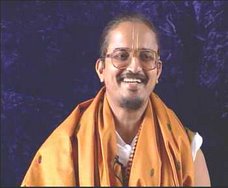
- His Holiness Sri Sri Muralidhara Swamiji


Chant the Mahamantra Nama kirtan :


Hare Rama Hare Rama Rama Rama Hare Hare
Hare Krishna Hare Krishna Krishna Krishna Hare Hare

Monday, May 19, 2008

The mind gradually gives up all agitation.........by the cultivation of devotion to the feet of Hari

Nama Article 20th May 2008


Prabodhasudhakara - Sri Adi Sankaracharya


Just as a tiger confined to a place surrounded by high walls makes repeated efforts to jump over the walls and, becoming exhausted, lies down panting, the mind, failing in its efforts to go out on account of the sense organs being restrained, becomes calm. Then it gives up all effort. 


The mind gradually gives up all agitation if the breath is controlled through pranayama, if the company of sages is resorted to, if the vasanas are given up, and by the cultivation of devotion to the feet of Hari.  The mind and the breath are like two sides of the same coin and so when one is controlled the other also becomes calm.


Restraint of the mind


If the mind is not allowed to go out towards external objects, but is fixed on the Self, it will become identified with the Self. When the mind is thinking of sense objects it becomes tainted and tamoguna predominates. When the mind withdraws itself from sense objects and attains dispassion towards them, sattvaguna will begin to manifest. (Prakriti, which is the material cause of the whole world is said to be composed of three gunas or modes, namely, sattva, rajas and tamas. The mind is also constituted of the same three gunas.


The proportion of these gunas varies from person to person. In the same person the proportion varies from time to time, depending on the activities of the mind, and one guna or other predominates. When sattvaguna predominates, the mind is calm, receptive to knowledge and pure. When rajoguna predominates, the person is actuated by greed and is inclined to engage in action for the fulfilment of his desires, heedless of the consequences. When tamoguna predominates, the person becomes lazy and goes into a torpor). The mind of the ordinary person constantly seeks pleasure through the sense organs. If the desired object is not attained the person thinks that he has lost something very valuable and is very unhappy.


Every one has to experience the consequences of his actions in this life or in past lives. This is the inexorable law. The only way to prevent the mind from running out in search of sense pleasures is by the cultivation of dispassion.

The happiness experienced in deep sleep is not born of any sense object because at that time there is no contact of the mind with external objects through the sense organs.


The mind gradually gives up all agitation if the breath is controlled through pranayama, if the company of sages is resorted to, if the vasanas are given up, and by the cultivation of devotion to the feet of Hari.  The mind and the breath are like two sides of the same coin and so when one is controlled the other also becomes calm.


Chant the Mahamantra Nama kirtan :


Hare Rama Hare Rama Rama Rama Hare Hare
Hare Krishna Hare Krishna Krishna Krishna Hare Hare

Though this is so, He can be attained through the scriptures and by contemplation on, and singing the praises of, Hari

Nama Article 19th May 2008
 
Prabodhasudhakara - Sri Adi Sankaracharya
 

The work commences with a salutation to Krishna, described as the Supreme Lord of the Yadava race, who is none other than the Unborn, Self-effulgent, Supreme Being, who is Pure Existence, Consciousness and Eternal Bliss. Thus the identity of the Personal God with Nirguna Brahman is established at the very outset.


The next verse points out that Brahman whom even the Vedas are unable to describe, is certainly not accessible to the words of human beings.


Though this is so, He can be attained through the scriptures and by contemplation on, and singing the praises of, Hari


Chant the Mahamantra Nama kirtan  :


Hare Rama Hare Rama Rama Rama Hare Hare
Hare Krishna Hare Krishna Krishna Krishna Hare Hare
Saturday, May 17, 2008

A mantra is that which protects us when we chant it.........we cannot, by analysis, discover the essence

Nama Article 18th May 2008
 

Excerpts from The Recitation of Mantra - by Swami Krishnananda direct disciple of His Holiness Swami Sivananda


System of the combination of particular words with other words of the requisite character is followed in the composition of a mantra, which literally means, 'that which protects a person who thinks of it'. Mananat trayate iti mantrah - a mantra is that which protects us when we chant it. It protects us like armour, like a shield that we wear in a war, by generating in us a resisting power against any kind of influence which is extraneous in nature, and which is unwanted for the purpose on hand. Chandas is the peculiar chemical combination of the letters, we may say. Particular chemical substances produce special results or effects when they are combined with certain types of other chemical components. But when they are mixed together, they may create a third force altogether.


A mixture that is chemically produced, like hydrogen and oxygen for instance, is not merely an arithmetical combination of two elements, because when the two are combined, some peculiar effect is produced which is not apparently present in either of the components. For instance, water is produced by a combination of hydrogen and oxygen, but we will not find the character of water either in hydrogen or in oxygen. The water that is the effect of the combination of hydrogen and oxygen in a certain proportion is a new effect altogether, and we cannot, by analysis, discover the essence of water in its original causes. Likewise, the words of a mantra, the components of a mantra, have special forces present or inherent in them, and when the words are combined in the requisite proportion and in the manner mentioned in the chandas shastra, they produce a third kind of effect which is the purpose or intention of the mantra, and that effect is called the devata. We may say that water is the devata of hydrogen and oxygen - it is the deity.


That is the intention. That is the purpose. That is what we require. That is what we are aiming at and want.


Chant the Mahamantra Nama kirtan :


Hare Rama Hare Rama Rama Rama Hare Hare
Hare Krishna Hare Krishna Krishna Krishna Hare Hare

The yoga sutras of Patanjali recommends Chanting the Divine Name

Nama Article 17th May 2008
 

The yoga sutras of Patanjali - Samadhi pada


तज्जपस्तदर्थभावनमः २८॥


tajjapastadarthabhāvanam .. 28..


Excerpts from The Recitation of Mantra - by Swami Krishnananda direct disciple of His Holiness Swami Sivananda


God is not any particular thing. He is the most general of all beings, satta samanya, as He is called, the universal substratum or the greatest common factor present in every conceivable thing, anywhere. Therefore, the designation of God should be possessed of similar characteristics - namely, it should be very comprehensive. That is, when the name of God is chanted, it is not that any particular finite idea is generated in the mind, but a vaster and more comprehensive notion is generated, which works in such a way that it removes the finitude of consciousness in our mind. Tajjapa tadarthabhāvanam (I.28) - 'japa' is the word used here in this sutra. Japa is a holy recitation, a constant hammering into the mind of a particular formula, an idea, or a name, in order that the same idea may be allowed to originate in the mind, and nothing else is allowed. The mind is made in such a way that it cannot think one and the same thing continuously and, therefore, it is necessary to repeat the designation or formula of a particular given object again and again, without any remission or gap, so that the mind reconstitutes itself into the form of that object, and there is a new type of vyapti or pervasion taking place in the mind, which is our intention in the recitation of the mantra.


Chant the Mahamantra Nama kirtan :


Hare Rama Hare Rama Rama Rama Hare Hare
Hare Krishna Hare Krishna Krishna Krishna Hare Hare

Thursday, May 15, 2008

Do not move away from a Sadhu or your Guru because he did not/does not speak to you

Nama Article 16th May 2008
 

Excerpts from a discourse by our Sri Sri Muralidhara Swamiji


Do not move away from a Sadhu or your Guru because he did not/does not speak to you.


Kabirdas explains, "We move with our neighbours, friends and relatives. If some misunderstanding arises with them feel happy and blessed. Just drop that relationship because if they are affectionate towards you, you will not come out of it. If any misunderstanding arises with Sadhus/your Guru, do not give it up as a blessing but somehow try to earn back their association. Do everything to earn their Grace back. Kabirdas gives a wonderful example for this - 'we go to the market and buy a 'măla' (chain) made of ordinary beads worth some 5 or 10 rupees for our child. When this breaks we throw it away as it is not of much worth. However, when the diamond or gold necklace bought for the child gets cut, we repair it and keep it safe. Relationship with other people is akin to the chain made of ordinary beads while association with Mahans is akin to diamond or gold necklace. Do not feel happy and blessed if their association gets cut. Go repeatedly to their Presence and somehow manage to bring about reconciliation.' He speaks on the glory of Satsangh and Sadhus. The reason for this is that he yearned very deeply for a Guru and attained Him with lots of difficulties.


Kabirdas, in spite of belonging to Islam religion, was attracted to Rama Năma. He desired to receive upadesa of this Mantra from Ramananda, a great Mahatama in Kăsi.


Kabirdas dressed up only as befitting his religion. Everyday he would go to the gates of Ramananda's ashram and await him. He would plead with everyone who walked out of this gate, "I desire to receive upadesa of Rama Năma from the Guru. Please recommend my case to him." But, none seemed to help him. Instead they advised him to chant the Mantra of his religion. He would plead, "No! My heart desires only Rama Mantra. Please speak about me to the Guru." Not at all discouraged by the words of others, he would stand at the gates of the ashram all through the day, everyday, without fail. He never once felt that he should not return here as none seemed to help him. For months he stood at the gates of the ashram, awaiting the Grace of the Guru. Mahans have no sleep. The 'Atma', remaining as a 'Săkshi', watches the body taking rest. This is a kind of 'nishtai'. Humans are caught in the three states of 'jagrat' (waking), 'swapna' (dream) and 'sushupti' (dreamless sleep). But, Mahans are in the fourth state of 'turiya'. Therefore, there is no sleep for them. When Ramananda was in this state, he heard the conversation between his 'puja murtis' Rama and Lakshmana. Rama told Lakshmana, "Oh! Lakshmana! Let us leave this ashram!"


Lakshmana asked the brother, "Brother! Why do you wish to leave this ashram?"


Rama explained, "There is a person coming to the gates of this ashram every day desiring to receive upadesa. But, none seem to help him. Why then should we remain here?"


Immediately, Ramanada pleaded with Rama, "Oh! Lord! I was not aware of this till now. I will find out and give upadesa to this person. You should not leave this ashram. You must remain here, please."


Early the next morning Ramananda took his 'kamandalu' and japa măla and wearing the 'Păduka' (Holy sandals) walked to Hanuman ghat on the banks of the Ganges for his bath. Kabirdas was lying on the steps leading to the river, weeping, "Today, too, I have not received upadesa of Rama Năma. I have not been able to receive the Grace of the Guru!" He lifted his head when suddenly the Păduka worn by Ramananda hit his head! Mahans always have the Lord's name on their tongue. Since, his foot hit against something in the dark, Ramananda uttered, 'Rama! Rama! Rama!' The Sun had not yet risen but Kabirdas looked at this Sun that was Ramananda! Ramananda stood there lustrous like the Sun! Kabirdas's heart leaped with joy as he heard Rama Năma uttered from the lips of the Guru. He thought, "I desired upadesa of Rama Mantra from the Guru. But, how blessed am I that I have received it at the banks of the Ganga with the blessings of the Guru's Păduka touching my head!" From that moment onwards Kabirdas began incessant japa of the 'Tăraka Mantra'. Due to his deep bhakti he attained the highest state.


Chant the Mahamantra Nama kirtan :


Hare Rama Hare Rama Rama Rama Hare Hare
Hare Krishna Hare Krishna Krishna Krishna Hare Hare